How We Use Scaffolding in Our Classrooms at Vygotsky School of Play
Building independence through guided support
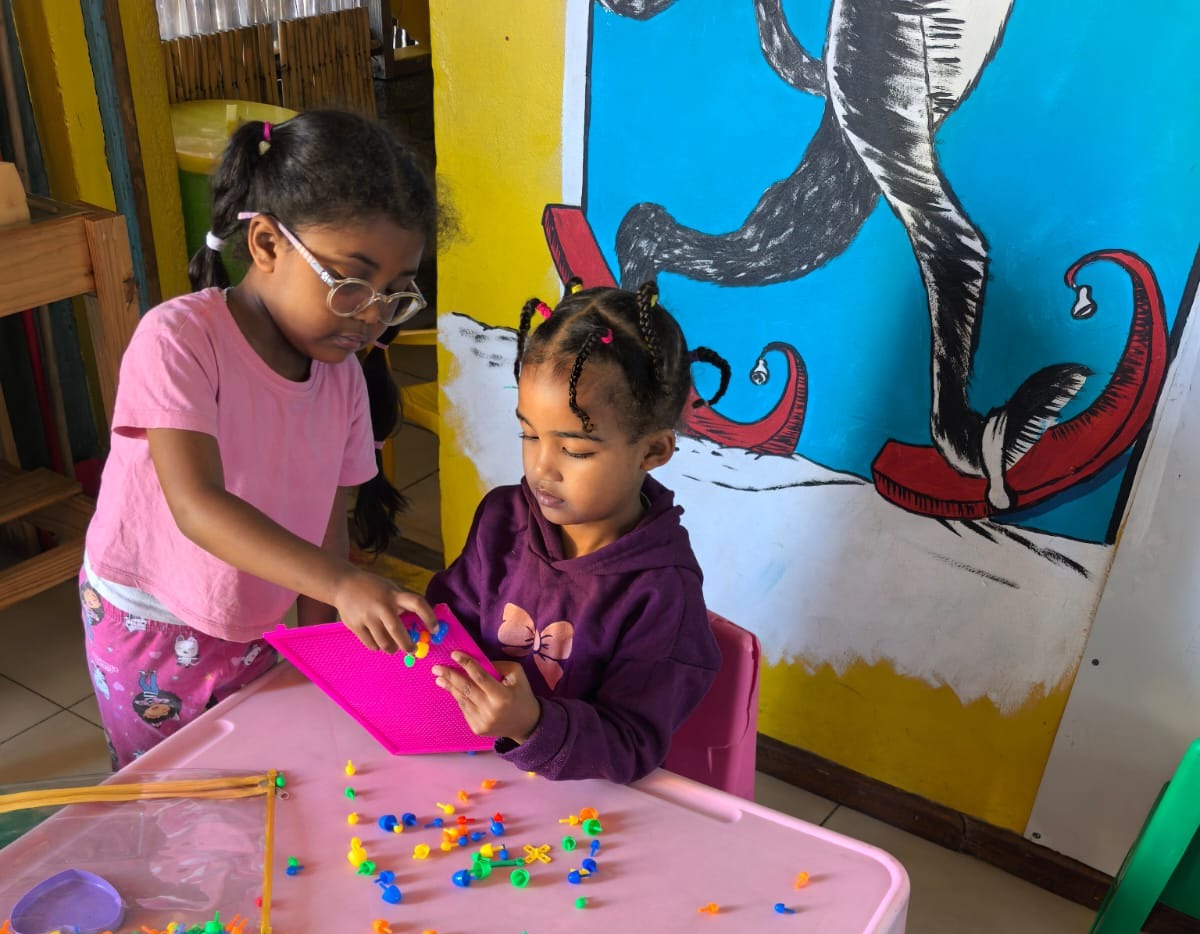
I gently explained to the teacher that left-handed scissors are designed differently, allowing children to see the cutting line clearly and use their natural hand strength. Then, I knelt down next to the little girl and asked her what part she would like me to help with. Together, we drew the shapes, and I asked if she wanted me or her friend to help her cut them. Confidently, she said she wanted to try herself.
A few minutes later, I noticed her cutting not only her own shapes but also helping a friend who was struggling. The two of them chatted happily as they worked side by side. I called the teacher's attention to this moment and said, "That is what scaffolding looks like — a minute ago, this child needed support, and now she's offering support to someone else."
At Vygotsky School of Play, this is the heart of how we learn and grow together. Scaffolding means giving just enough help for a child to succeed — and then gently stepping back as their confidence and independence grow. It's about meeting children where they are, guiding them through challenges, and celebrating when they can stand on their own.
We believe that every moment in the classroom is a chance to build not just skills, but self-belief. And often, those moments of gentle guidance turn into the most powerful lessons — where one child's success becomes the spark for another's learning.
Understanding Vygotsky's Theory of Scaffolding
Our school's name honors Lev Vygotsky, the Soviet psychologist whose groundbreaking work in the 1920s and 1930s transformed how we understand children's learning and development. His theories form the foundation of everything we do in our classrooms.
The Zone of Proximal Development
At the heart of Vygotsky's theory is the concept of the Zone of Proximal Development (ZPD). This is the sweet spot between what a child can do independently and what they can achieve with guidance and support.
Vygotsky identified three learning zones:
- What the child can do alone - Tasks they've already mastered
- The Zone of Proximal Development - Tasks they can accomplish with help
- What is beyond current reach - Tasks too difficult even with support
The ZPD is where real learning happens. It's that space where a child is challenged but not overwhelmed, where they can stretch their abilities with the right support. This morning's scissor moment was a perfect example: cutting shapes was just beyond this little girl's independent ability, but with the right tool and gentle guidance, she moved through her ZPD and emerged capable and confident.
Scaffolding: The Bridge Across the ZPD
While Vygotsky introduced the concept of the ZPD, the term "scaffolding" was later coined by psychologist Jerome Bruner to describe the temporary support that helps children cross this developmental bridge. Like scaffolding on a building, educational scaffolding provides:
- Temporary support that is gradually removed as the child gains competence
- Adjustable assistance that responds to the child's current level of understanding
- A framework that enables children to accomplish tasks they couldn't complete alone
Effective scaffolding involves several key elements:
Breaking down tasks: Complex activities are divided into manageable steps. In our scissor example, we separated drawing the shapes from cutting them, allowing the child to focus on mastering one skill at a time.
Providing the right tools: Sometimes scaffolding means ensuring children have access to appropriate materials. Left-handed scissors weren't just helpful — they were essential for this child's success.
Modeling and demonstration: Children learn by watching more skilled individuals. The teacher and I modeled how to approach the problem, showing the child that challenges can be solved.
Asking guiding questions: Rather than doing everything for the child, we asked what help she needed and what she wanted to try herself. This promoted independence and decision-making.
Offering encouragement: Emotional support is part of scaffolding too. Believing in a child's ability to succeed helps them believe in themselves.
The More Knowledgeable Other (MKO)
Vygotsky emphasized that learning is fundamentally social. Children develop higher-level thinking through interactions with a More Knowledgeable Other (MKO) — anyone with greater understanding of a task, whether a teacher, parent, or peer.
What made this morning's moment so powerful was watching the transformation: the little girl went from needing support to becoming the MKO for her struggling friend. This peer-to-peer scaffolding is incredibly valuable. When children teach each other, both learners benefit — the one receiving help gains new skills, while the one offering support deepens their own understanding and builds confidence.
Language and Thought
Vygotsky believed that language plays a crucial role in cognitive development. Through conversation and dialogue, children internalize new concepts and ways of thinking. Notice how we used language throughout the scissor activity:
- Explaining why left-handed scissors are different
- Asking the child what help she needed
- Encouraging her to verbalize her choice
- Watching her chat with her friend as they worked together
These verbal interactions weren't just pleasant conversation — they were essential tools for learning. Through dialogue, children organize their thoughts, plan their actions, and eventually develop the ability to guide themselves through challenges using inner speech.
Cultural-Historical Context
Vygotsky emphasized that learning doesn't happen in isolation. Children develop within a cultural and social context, and the tools, practices, and knowledge valued by their community shape what and how they learn.
In our classroom, we create a culture that values:
- Collaboration over competition
- Problem-solving over perfection
- Independence built on supported practice
- Children as capable learners who help one another
This cultural approach is itself a form of scaffolding — we're building not just individual skills, but a community of learners who support each other's growth.
Scaffolding in Practice at Vygotsky School of Play
Every day, our teachers look for opportunities to work within each child's ZPD. We observe carefully to understand what each child can do independently and where they need support. We provide tools, ask questions, offer encouragement, and model skills — always with the goal of fostering independence.
And we watch for those beautiful moments when scaffolding has done its work: when tears turn to smiles, when "I can't" becomes "I can," and when a child who needed help becomes the helper.
Because that's what Vygotsky understood so deeply: learning is not a solitary journey. We grow through our relationships, through the support we receive and the support we give. We learn by doing things we couldn't do alone — until suddenly, wonderfully, we can.
That's the power of scaffolding. That's the magic of learning through play. That's the legacy of Vygotsky, alive and thriving in our classrooms every day.
About the Author

Nadine Nelson is the passionate founder of Vygotsky School of Play and Vygotsky School of Diverse Minds, where learning through play is at the heart of everything. With over 15 years of experience in Early Childhood Development (ECD), Nadine believes that children learn best through hands-on, real-life experiences that nurture the whole child — socially, emotionally, cognitively, and physically.
Drawing inspiration from theorists like Vygotsky, Erikson, and Bandura, she creates learning environments where play, creativity, and connection come together to help each child reach their full potential.
Through her blog, Nadine shares practical tips, sensory play ideas, classroom inspiration, and parent guidance to help educators and families support children's growth in meaningful, playful ways.
When she's not in the classroom, you'll find her spending time with her husband and three daughters, dreaming up new ways to make learning fun for every child.